

Celebrating Books 4 PNG Kids
- Melissa R
- Dec 13, 2018
- 2 min read
We come from a country where educational opportunities and resources are bountiful. So bountiful in fact, that 'old' books are often considered worthless and are recycled or trashed!
Books 4 PNG Kids are helping to turn 'trash' into treasure by collecting spare books for 0-14-year-olds from schools and libraries and transporting them all the way to Papua New Guinea.
At this time of year you might be cleaning out the books in your library, and if you are in Melbourne or QLD, please think of Books 4 PNG Kids.
As an island, Papua New Guinea is isolated and relies on people to bring in resources- many areas remain remote with no roads, and schools might have little to no books to teach with. School is not compulsory, and fewer girls attend than boys. T.V and internet are rare, so books are precious.
I grew up with a book stockroom at my house so I can't even imagine suffering a lack of books! Books are a window into possibilities. By providing a wonderful variety of resources, Books 4 PNG Kids are helping to create an engaging educational experience for kids who might have no other knowledge of the world outside their villages. These kids are strong and independent and there is no limit to what they can do!
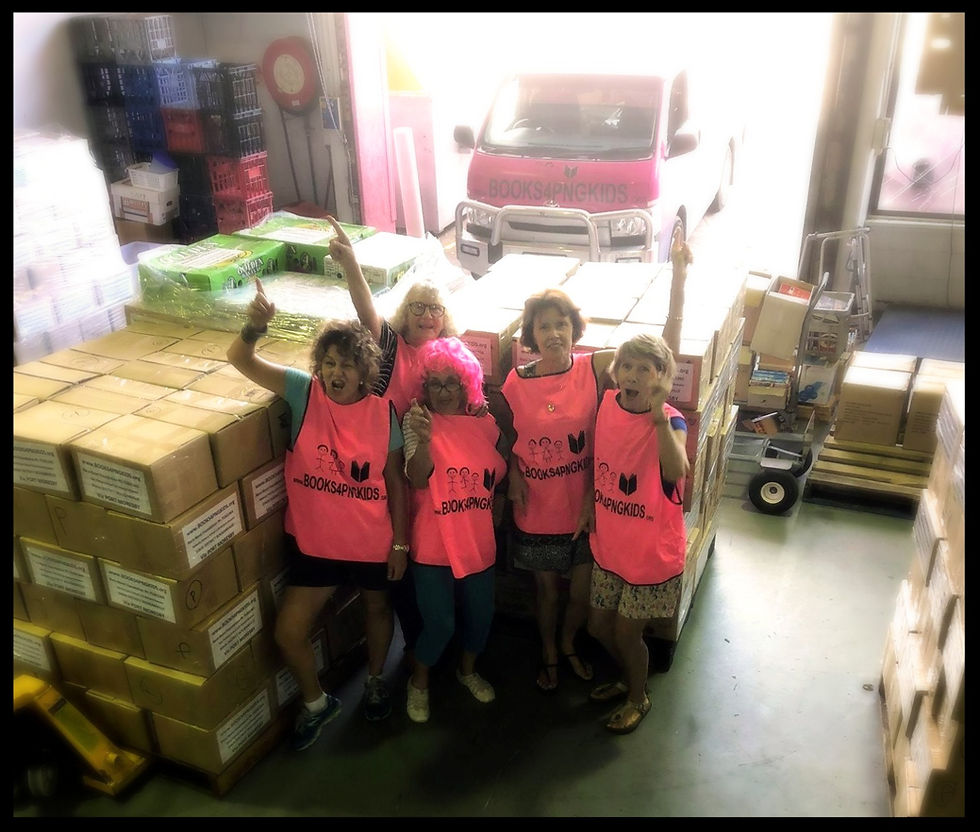
If you can help, there are fun Friday packing days (pictured here are the girls, including the CEO of Books 4 PNG Kids and the CEO of Enlighten Press, celebrating a new shipment ready to go!) 👏
You can also help by donating books.
These are the kinds of resources suitable for donation:
✔Early Readers (numbers, alphabet, picture books, animals and cardboard books)
✔Primary school fiction and non-fiction
✔Basic School Supplies
✔Atlases and world maps
✔Dictionaries and thesauruses
✔Bibles
✔Education games and wooden puzzles
✔Medical, nursing and midwifery textbooks
✔Musical instruments
If you would like to know more, visit this page-
Happy holidays!




The article presents an important analysis of how we perceive the value of educational resources based on geographic context. The mention https://financedistrict.co.nz/ of Royal Reels highlights the disparity in how abundance can render https://royalreels22.com/ materials as surplus in one area while being desperately needed in another. This raises critical questions about our responsibilities in resource allocation and the systemic inefficiencies that often accompany such redistributions.
What stays with me in efforts like this is how differently value is assigned depending on where abundance exists. Somewhere around Vegas Now the story stops being only about donated https://www.vegasnow.com/ books and becomes about dignity, access, and whether education is treated as excess in one place but essential infrastructure in another.
What stays with me in efforts like this is the imbalance in how value gets assigned depending on where abundance exists. Somewhere around https://www.bodyblueprint.co.nz/ Winspirit the story stops being https://winspirit.com/ only about donated objects and becomes about redistribution, dignity, and whether access to learning is treated as surplus or as infrastructure.
Projects like this also highlight an uncomfortable truth about abundance: value often depends more on context than on condition. What one system discards can still carry real social weight elsewhere, and even ordinary tools like https://pokeplay.io/ Pay ID show how infrastructure quietly decides whether https://esportsinsider.com/au/gambling/payid-casinos access feels simple or out of reach.
The shift from surplus to scarcity really highlights how value depends on context rather than the item itself. Redistribution efforts like this reveal inefficiencies in how resources circulate, similar to how environments influence habits around https://www.arg.org.nz/ The Pokies where availability and framing https://thepokies119.net/ can redefine what people consider worthwhile.