

Movement, Mood and Learning: What Happens Inside a Child’s Body

Children already know that movement changes something.
They run and feel brighter. They curl up and feel quieter. They jump, spin, climb, wobble, stretch, fall over, try again, and somehow their whole body joins the conversation.
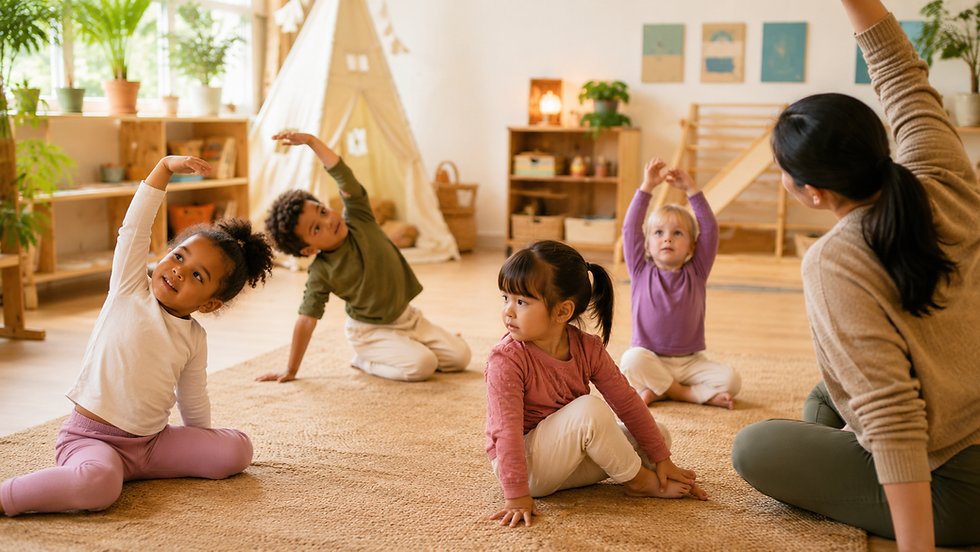
That is the heart of MOVE. Exploring movement, mood and learning.
This book is not simply about exercise. It is about helping children see that movement is one of the ways the body communicates, adapts, learns and feels. When a child moves, muscles, bones, breath, blood, nerves and brain are not working as separate parts. They are working together as one living system.
The visual overlays in MOVE are designed to make that invisible work visible. Children can see muscles engaging, lungs responding, signals moving, and the brain lighting up as the body acts. The aim is not to give children a technical anatomy lesson, but to give them a sense of wonder and agency: my body is doing things, and I can learn to notice them.
Current research gives weight to this approach. Studies on physical activity, executive function and embodied learning increasingly suggest that movement is not separate from thinking. For children, movement can support attention, self-regulation, memory, coordination and learning readiness, especially when movement asks them to respond, adapt, coordinate and think while they act.
Movement is a whole-body conversation
It is tempting to think of movement as something that happens mainly in the arms and legs. A child runs, so their legs are moving. A child climbs, so their arms are working. A child jumps, so their muscles must be busy.
All true, but incomplete.
When a child moves, the heart, lungs, blood, muscles, bones, nerves and brain all respond together. Breathing changes so more oxygen can enter the body. Blood carries oxygen and nutrients to working muscles. The nervous system sends messages about balance, pressure, speed and position. The brain uses that information to adjust, predict and try again.
That is one of the central ideas of MOVE: the body is not a collection of isolated parts. It is a connected system.
This whole-system view aligns with the broader movement science and education research that links physical activity with cognitive development, executive function and learning readiness. School-based reviews have found that movement can support executive function, particularly when activities are cognitively engaging rather than purely repetitive.
In classroom terms, this means movement does not need to be treated as a break from learning. It can be part of learning.

Movement helps the brain change
One of the most exciting ideas in MOVE is that movement can help the brain grow and change.
For children, this can be explained simply: when they move, practise and try new things, their brain builds and strengthens pathways. The more they use those pathways, the more skilled and confident they can become.
For adults, the science is more nuanced. Research into physical activity and neuroplasticity often discusses brain-derived neurotrophic factor, or BDNF, a protein involved in neuronal survival and synaptic plasticity. Recent reviews suggest that exercise interventions can influence BDNF in children and adolescents, although this area is still developing and should not be oversimplified into “one movement break grows the brain.”
There is also evidence that physical training can change patterns of brain activation linked with attention and inhibitory control. One 2024 study found that a 12-week physical training program improved inhibitory control in children and increased activation in the right dorsolateral prefrontal cortex during a cognitive task.
So yes, it is fair to say that movement supports brain development, as long as we keep the language honest. Movement is not magic. It is one of the natural ways children practise, adapt and strengthen the brain-body systems they rely on every day.
Trying, wobbling and mistakes are part of learning
This may be one of the most important messages in the book.
Children often hear that they should “get it right.” But movement teaches something deeper: trying, wobbling, missing, falling and adjusting are not signs that learning has failed. They are often how learning happens.
Motor learning depends on feedback. A child reaches, misses, shifts their balance, tries again, changes the timing, and gradually finds a better way. The body is not simply repeating instructions; it is exploring.
Research on motor learning supports this. A 2025 review found that executive function gains are often linked with motor learning contexts, particularly when children are acquiring new skills through varied practice. Another 2025 study found that children increased movement variability after failed trials, effectively searching for a better solution, while after successful trials they repeated the pattern more consistently.
This is a beautiful idea for children to grow up with.
Mistakes are not proof that they cannot do something. Mistakes are information. Trying again is the body and brain working together.
Movement can change how children feel
Children often discover this before adults explain it.
A child who feels flat may become brighter after running outside. A child who feels scattered may settle after slow stretching or heavy work. A child who feels tense may find rhythm, pressure or repetition calming.
This does not mean movement fixes every feeling, and it definitely does not mean every child responds in the same way. But it does mean that movement can be part of a child’s toolkit for noticing and shifting state.
Research supports a careful version of this idea. A teacher-delivered rhythm-and-movement program was found to improve self-regulation in preschool-aged children, and reviews of physical activity and self-regulation in early childhood suggest the strongest links are often with behavioural self-regulation. Exercise interventions have also been associated with reductions in negative emotions such as anxiety, stress and low mood in children, although individual needs and contexts matter.
In MOVE, this becomes a child-friendly idea:
Different kinds of movement can help me feel different things.
Fast movement might energise. Slow movement might steady. Stretching might help the body feel organised. Jumping might help release restlessness. Cross-body movement might help a child focus on where their body is in space.
The book is not telling children how they should feel. It is inviting them to notice what changes.
Cross-body movement and coordination
The book also introduces a simple cross-body movement children can do along with the reading.
This kind of movement is sometimes described casually as “getting both sides of the brain working together.” That is acceptable shorthand with young children, but in adult-facing educational language it is better to be more precise.
Cross-body or cross-lateral movement asks the two sides of the body to coordinate across the midline. It involves timing, attention, spatial awareness, balance and communication across neural systems. Research on coordinated bilateral ball skills found gains in concentration performance and attention span, and neuroscience research continues to emphasise the importance of communication between the brain’s hemispheres for integrated function.
So the point is not that one movement “balances the brain” in a simplistic left-brain/right-brain way. The stronger, more accurate idea is this:
Cross-body movement gives children a chance to coordinate, organise and pay attention through the body.
That is useful in early learning. It is also very accessible. A child can tap an opposite elbow to a raised knee, cross one hand to the opposite side, crawl, climb, march, dance, throw, catch, or move through playful patterns that ask the body to work across the midline.
Movement can look many different ways
One of the values of MOVE is that it expands what movement can mean.
Movement does not only mean sport. It does not only mean running laps, joining a team, doing formal exercise, or being “good at PE.”
Movement can be climbing, balancing, crawling, spinning, rolling, stretching, dancing, kicking, marching, stomping, tiptoeing, throwing, pushing, reaching, twisting, wobbling or inventing something completely new.
That matters because children need to see movement as something that belongs to them.
Some children love speed. Some love rhythm. Some prefer quiet movement. Some enjoy pressure, resistance or balance. Some children do not identify as sporty at all, but still love to move in imaginative, sensory or playful ways.
Global health guidance also supports the idea that movement should be varied, enjoyable and age-appropriate. The World Health Organization and CDC both emphasise regular physical activity for children, but in practice, the most meaningful early childhood movement is often playful, varied and woven into everyday life.
This is why the images in MOVE show many kinds of children doing many kinds of movement. The goal is not to present one ideal way to move, but to help children ask: What kind of movement feels good for me?
Making invisible body systems visible
The visual overlays in MOVE are central to the book’s purpose.
Children can see movement from the outside, but they cannot see the muscles engaging, the blood moving, the lungs responding or the brain receiving signals. Those processes are usually invisible, which makes them harder to understand.
The overlays act as a bridge between what children can see and what they can begin to imagine.
There is educational support for this kind of visual scaffolding when it is done thoughtfully. Research on multiple representations in learning suggests that combining words and images can support understanding, particularly when the representations are coherent and connected rather than decorative or distracting. Embodied learning research also supports the value of linking physical action with thinking.
This is also where the AI-assisted imagery has a clear educational purpose.
The images were not created to make the book look futuristic or flashy. They were created because standard stock photography cannot show a child what is happening inside the body when they move. With carefully designed visual overlays, children can connect action with internal response. They can see movement as something alive, intelligent and whole-body.
For a child, that can change the question from:
“Do I have to move?”
to:
“What is my body doing when I move?”
That is a much richer starting point.
Movement as agency
At its heart, MOVE is about agency.
Children are not simply being told to move because adults say it is healthy. They are being invited to understand what movement does, how it feels, and how they might use it.
A child who notices that jumping helps them feel energised has learned something useful. A child who discovers that slow stretching helps them settle has learned something useful. A child who realises that wobbling during balance practice is part of learning has learned something useful.
This is body awareness in action.
It is also a positive psychology lens: not forced compliance, not shame, not “exercise because you should,” but curiosity, choice, confidence and self-knowledge.
A book for classrooms, not just bodies
In early education settings, movement often gets squeezed around the edges of the day. It happens outside, in transition moments, or when children “need to get their energy out.”
But movement can be much more than a release valve.
It can be a way into science, health, self-regulation, language, observation, inquiry and confidence. It can help children connect what they do with what they feel. It can help educators talk about the body without turning the conversation into rules, performance or pressure.
MOVE was created for that space.
It helps children see that their bodies are not just carrying them through the day. Their bodies are thinking, learning, responding, adjusting and communicating all the time.
And once children begin to see that, movement becomes more than activity.
It becomes a way of knowing themselves.


There are countless suggestions when it comes to online casinos in Australia, so I usually look for recommendations that sound natural instead of exaggerated. The most useful comments are the ones where people explain why they continue using a particular platform instead of simply saying it's the best. During my search, Mindil Beach Casino stood out because different players kept mentioning similar strengths, including an easy-to-use layout, a wide range of games, and a consistently pleasant experience. Seeing the same points repeated across unrelated discussions gave me much more confidence than any polished advertisement ever could.
Reading about how movement actually MafiaCasino rewires a child's brain for learning makes so much sense when I think back to my own restless school days. It's refreshing to see the science laid out so clearly—no fluff, just practical insights about why fidgeting isn't failure. I'm already planning more outdoor breaks for my kids, not as rewards but as essential parts of their study routine.
I came across a forum where people were talking about nightlife and leisure spots in Australia. I was mostly browsing without a goal, just reading how locals in Sydney describe their weekends. At one point someone referenced https://mafiacasino1-aus.com while explaining how they planned an evening with colleagues. That small detail made me scroll further through the thread. I noticed that people weren’t focused on one aspect only, but instead talked about the whole experience around the area. It helped me understand how these places are integrated into everyday city life rather than being standalone attractions.
Hi all, I came across Paradise 8 Casino through a sports forum where AU were discussing sites that actually work well on slower internet connections. Since my Wi-Fi acts up constantly, that immediately got my attention. I opened it one rainy night expecting nothing special, but the pages loaded surprisingly fast even while my connection struggled. What I liked most was not having to search forever for the games I wanted. During one session I kept losing tiny bets and was seconds away from quitting for the night, then somehow landed a lucky feature that completely reversed the situation. I ended up staying awake way too late because I couldn’t believe my luck had finally changed. It’s one of the…